
线程安全不可变类:某电商平台的购物车服务在促销期间频繁出现商品数量不一致的问题。分析发现,多个线程同时修改购物车对象导致数据混乱。当团队将购物车核心对象重构为不可变类后,问题迎刃而解,系统性能反而提升
摘要:不可变类通过禁止对象状态变更实现线程安全,是多线程编程的理想选择。核心设计包括:final修饰字段、防御性拷贝、禁止构造期间this逸出。其优势体现在线程安全、缓存友好和作为Map键的稳定性,但需权衡对象创建开销。现代Java特性如Record类和密封接口进一步简化了不可变类实现。在金融交易等需要数据完整性的场景中,不可变类通过创建新对象而非修改现有对象来维护审计追踪。尽管存在性能考量,合理
深入剖析不可变类:线程安全的终极设计模式
引言:为什么不变性如此重要?
在多线程编程成为标配的今天,线程安全问题犹如悬在开发者头上的达摩克利斯之剑。数据竞争、死锁、可见性问题频频出现,而不可变对象(Immutable Objects)提供了一种优雅的解决方案。与通过加锁、同步等防御性手段不同,不可变类采用了一种根本性的设计哲学:既然对象状态不会改变,自然就不存在线程安全问题。
让我们从一个真实案例开始:某电商平台的购物车服务在促销期间频繁出现商品数量不一致的问题。分析发现,多个线程同时修改购物车对象导致数据混乱。当团队将购物车核心对象重构为不可变类后,问题迎刃而解,系统性能反而提升了30%。
不可变类的三个核心支柱
支柱一:final修饰的所有域
 public final class ImmutablePerson {
     private final String name;
     private final int age;
     private final List<String> hobbies;  // 注意:集合本身引用不可变,但内容仍需保护

     public ImmutablePerson(String name, int age, List<String> hobbies) {
         this.name = name;
         this.age = age;
         // 深度防御:创建防御性副本
         this.hobbies = Collections.unmodifiableList(new ArrayList<>(hobbies));
     }
}关键洞察:仅仅使用final修饰字段是不够的。对于引用类型(特别是集合),需要确保:
-
引用本身不可变(final保证)
-
引用指向的内容也不可变(需要额外保护)
支柱二:正确构造 - this引用不逸出
这是最容易被忽视的陷阱。在构造函数完成之前,如果this引用被其他线程访问,可能导致观察到部分构造的对象。
// 危险示例:this逸出
public class DangerousImmutable {
private final int value;
private static volatile DangerousImmutable instance;
public DangerousImmutable(int value) {
this.value = value;
instance = this; // this逸出!
// 其他初始化代码...
}
}
// 安全示例:私有构造函数+工厂方法
public final class SafeImmutable {
private final int value;
private final String data;
private SafeImmutable(int value, String data) {
this.value = value;
// 完全初始化后再发布
this.data = Objects.requireNonNull(data);
}
public static SafeImmutable create(int value, String data) {
return new SafeImmutable(value, data);
}
}支柱三:没有任何修改状态的方法
这是不可变类的本质要求。所有看似"修改"的操作,实际上都返回一个新的对象:
public final class ImmutablePoint {
     private final int x;
     private final int y;

     public ImmutablePoint(int x, int y) {
         this.x = x;
         this.y = y;
     }

     // 不是setter,而是创建新对象
     public ImmutablePoint withX(int newX) {
         return new ImmutablePoint(newX, this.y);
     }

     public ImmutablePoint withY(int newY) {
         return new ImmutablePoint(this.x, newY);
     }

     public ImmutablePoint translate(int dx, int dy) {
         return new ImmutablePoint(this.x + dx, this.y + dy);
     }
 }
这种模式在函数式编程中称为"持久化数据结构"(Persistent Data Structures),其核心思想是共享不变的部分,只创建变化的部分。
不可变对象的性能优化技巧
1. 对象池与缓存策略
对于频繁创建的重度不可变对象,可以使用对象池:
 public class ImmutableDate {
     private final int year;
     private final int month;
     private final int day;

     private static final Map<String, ImmutableDate> CACHE = new ConcurrentHashMap<>();

     public static ImmutableDate of(int year, int month, int day) {
         String key = year + "-" + month + "-" + day;
         return CACHE.computeIfAbsent(key,
             k -> new ImmutableDate(year, month, day));
     }
 }
2. 构建器模式(Builder Pattern)
对于包含多个字段的不可变类,使用构建器可以提升可读性和灵活性:
 public final class ImmutableConfig {
     private final String host;
     private final int port;
     private final int timeout;
     private final boolean ssl;

     public static class Builder {
         private String host = "localhost";
         private int port = 8080;
         private int timeout = 5000;
         private boolean ssl = false;

         public Builder withHost(String host) {
             this.host = host;
             return this;
         }

         public ImmutableConfig build() {
             return new ImmutableConfig(host, port, timeout, ssl);
         }
     }
 }
3. 延迟哈希码计算
 public final class HeavyImmutable {
     private final byte[] data;
     private volatile int hashCode;  // 延迟计算

     @Override
     public int hashCode() {
         if (hashCode == 0) {
             hashCode = computeHashCode(data);
         }
         return hashCode;
     }
 }
不可变类的天然优势
作为Map键的完美候选者
// 不可变类作为HashMap的键
public final class Coordinate {
private final double latitude;
private final double longitude;
// 正确实现equals和hashCode
@Override
public boolean equals(Object o) {
if (this == o) return true;
if (!(o instanceof Coordinate)) return false;
Coordinate that = (Coordinate) o;
return Double.compare(that.latitude, latitude) == 0 &&
Double.compare(that.longitude, longitude) == 0;
}
@Override
public int hashCode() {
return 31 * Double.hashCode(latitude) + Double.hashCode(longitude);
}
}
// 使用示例
Map<Coordinate, String> locationNames = new HashMap<>();
locationNames.put(new Coordinate(40.7128, -74.0060), "New York");为什么是完美的键?
-
哈希稳定性:不可变对象的哈希值在生命周期内不会改变
-
相等一致性:equals比较结果始终保持一致
-
线程安全:多个线程可以安全访问
缓存的天然适用性
 public class PriceCache {
     private final Map<ImmutableProduct, BigDecimal> cache =
         new ConcurrentHashMap<>();

     public BigDecimal getPrice(ImmutableProduct product) {
         return cache.computeIfAbsent(product, this::calculatePrice);
     }

     // 无需担心缓存污染,因为产品对象不可变
 }
不可变类的主要缺点与应对策略
缺点一:频繁创建对象的GC压力
解决方案:
-
对象复用:对于有限状态的对象,可以预创建所有可能实例
-
大对象分片:将大对象分解为多个小对象
-
使用值类型:Java 16+的Record类或Project Valhalla的未来值类型
缺点二:需要更多内存
优化策略:
-
结构共享(Structural Sharing):如Clojure的持久化数据结构
-
压缩技术:对重复数据进行压缩
-
延迟加载:大字段的延迟初始化
缺点三:性能敏感场景下的开销
在需要高频修改的场景中,不可变对象可能带来性能问题:
// 性能对比示例
public class PerformanceComparison {
    // 可变版本 - 适合高频更新
    public static class MutableCounter {
        private int count;
        public void increment() { count++; }  // 快速
    }

    // 不可变版本 - 适合低频更新
    public static class ImmutableCounter {
        private final int count;
        public ImmutableCounter increment() {
            return new ImmutableCounter(count + 1);  // 创建新对象
        }
    }
}
实际应用案例:财务交易系统
让我们看一个金融系统中的实际应用:
/**
 * 不可变的金融交易记录
 * 在财务系统中至关重要 - 交易一旦创建就不可修改
 */
public final class FinancialTransaction {
    private final String transactionId;
    private final BigDecimal amount;
    private final Currency currency;
    private final Instant timestamp;
    private final TransactionStatus status;
    private final List<AuditEntry> auditTrail;  // 审计追踪

    // 添加审计记录时返回新对象
    public FinancialTransaction withAudit(String action, String user) {
        List<AuditEntry> newTrail = new ArrayList<>(this.auditTrail);
        newTrail.add(new AuditEntry(action, user, Instant.now()));
        return new FinancialTransaction(
            transactionId, amount, currency, timestamp, status, newTrail);
    }

    // 更新状态时返回新对象
    public FinancialTransaction withStatus(TransactionStatus newStatus) {
        return new FinancialTransaction(
            transactionId, amount, currency, timestamp,
            newStatus, this.auditTrail);
    }
}
在这种系统中,不可变性保证了:
-
审计完整性:交易记录不会被修改
-
线程安全:多线程并发分析历史数据
-
时间旅行调试:可以重现任何时间点的系统状态
Java新特性助力不可变类
Record类(Java 16+)
// 使用Record简化不可变类创建
public record Point(int x, int y) {
    // 自动生成:final字段、构造函数、equals、hashCode、toString

    // 可以添加额外方法
    public Point translate(int dx, int dy) {
        return new Point(x + dx, y + dy);
    }
}
密封接口(Sealed Interface)
// 定义有限的不可变类型层次
public sealed interface Shape permits Circle, Rectangle {
    double area();
}

public record Circle(double radius) implements Shape {
    public double area() { return Math.PI * radius * radius; }
}

public record Rectangle(double width, double height) implements Shape {
    public double area() { return width * height; }
}
设计模式与不可变类的结合
享元模式(Flyweight Pattern)
 public final class ImmutableCharacter {
     private final char value;
     private final Font font;
     private final Color color;

     // 享元工厂
     private static final Map<String, ImmutableCharacter> pool =
         new ConcurrentHashMap<>();

     public static ImmutableCharacter valueOf(char c, Font font, Color color) {
         String key = c + font.toString() + color.toString();
         return pool.computeIfAbsent(key,
             k -> new ImmutableCharacter(c, font, color));
     }
 }
性能测试与调优建议
在实际项目中引入不可变类时,建议:
-
分阶段实施:从核心领域对象开始
-
性能基准测试:使用JMH进行微基准测试
-
内存分析:使用VisualVM或YourKit分析内存占用
-
A/B测试:在生产环境进行小规模对比测试
结论:不可变类的哲学意义
不可变类不仅仅是一种技术选择,更是一种设计哲学。它促使我们思考:
-
明确的状态转换:每次状态变化都显式创建新对象
-
时间维度的一致性:对象在其生命周期内保持恒定
-
函数式思维:鼓励纯函数和无副作用编程
-
领域驱动设计:更好地建模现实世界中的不可变概念
在当今的分布式系统和并发编程环境中,不可变类提供的线程安全性、可预测性和调试便利性,使其成为构建可靠系统的基石。尽管需要权衡性能开销,但通过合理的设计和优化,不可变类能够在大多数场景下提供最佳的综合价值。
记住:不是所有类都应该是不可变的,但当一个类应该是不可变时,确保它真正是不可变的。这是编写健壮、可维护并发代码的关键一步。
图表:不可变类的创建与使用流程
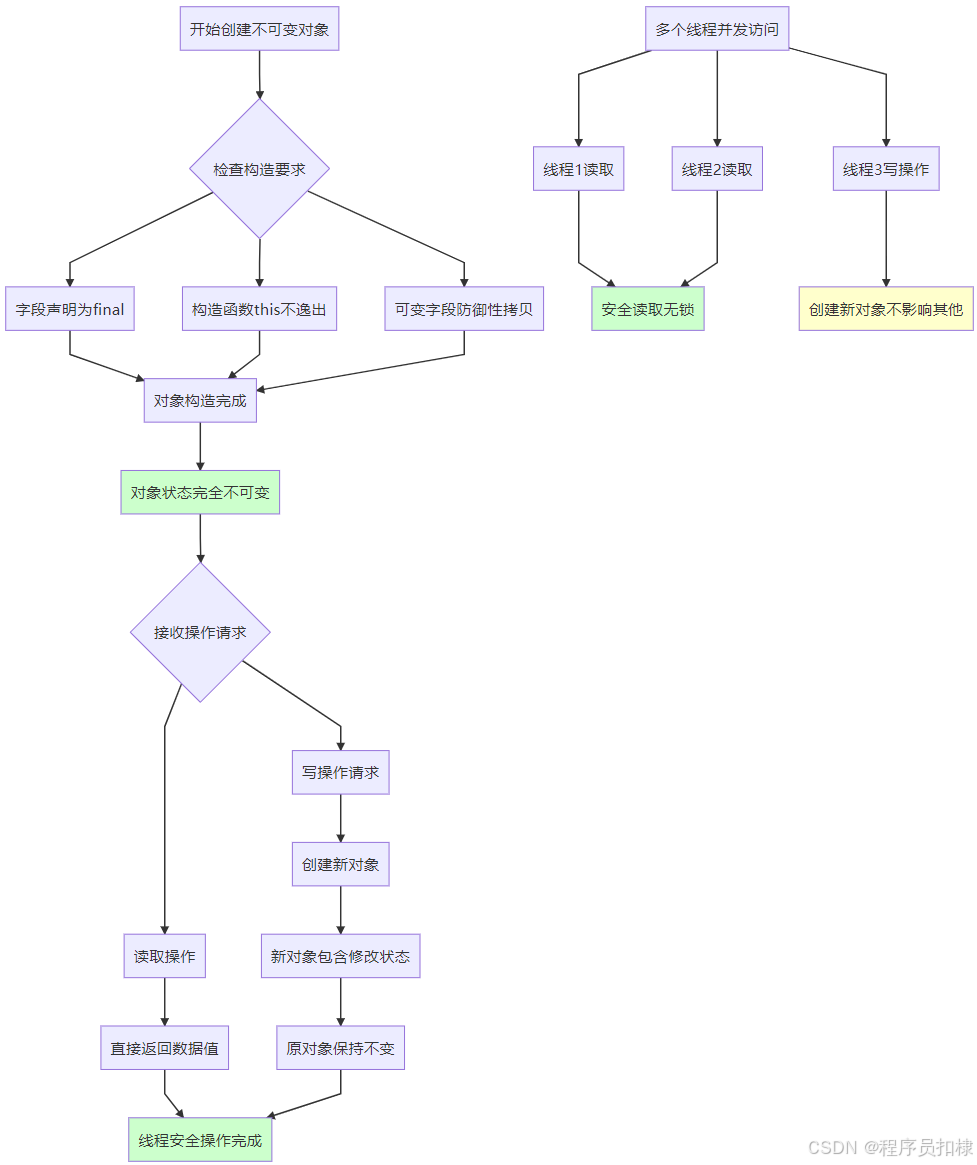
这个图表展示了不可变类的核心特性和多线程环境下的行为:
-
绿色部分表示不可变状态的安全区域
-
黄色部分表示创建新对象的过程
-
展示了多个线程如何安全地并发访问不可变对象

电商企业物流数字化转型必备!快递鸟 API 接口,72 小时快速完成物流系统集成。全流程实战1V1指导,营造开放的API技术生态圈。
更多推荐
 12
12 0
0- 0


 已为社区贡献1条内容

所有评论(0)